Translate

Showing posts with label Marine. Show all posts

Sunday, 11 November 2018

FISHING DEVICES IN INDIA - Fish Traps and Hook & Lines

India is blessed with abundant water resources in different forms and with diverse fish fauna. So the fishing techniques are also have much importance. Different kinds of fishing techniques are practiced in India from earlier days. These methods are wide in range from hand picking to modern trawl.
The craft and gears used in different areas are different by their design based on the fish species, available materials in the geographic region. Also based on the nature of aquatic resource. The gears are classified in many manner, Including use, materials used to make, shape etc. Fish traps and hook& line are the most primitive type of fishing gears.

Fish Traps

Trapping- an earliest method of fishing. Traps- impounding devices into which an organism is lured and troy which escape is made difficult because of the non-return device is fixed at the entrance
According to Job &Pantulu, traps being fixed engines do not require continuity of attention and vigilance on the part of the operation but can be left to function themselves and secure a catch while the operator is engaged in other occupation. Trap fishing have economic and energy related advantages over the active search and capture fisheries. They require modest investment and due to their efficiency, simplicity and the quality of catch obtained, this method is widely used in all water bodies. 
In trapping the fish remain live or in good condition for a long time. Fish traps are operated in both inland and marine waters throughout India because of it is an eco friendly method. The artisanal fishermen in inland waters use primitive models of trapping. Modern traps are generally made up of plastics replacing the conventional bamboo sticks etc. and having separate part which can be assembled and dismantled easily.
Traps made up off twigs of Palmyra leaf and bamboo splinters are used in Tamilnadu, Kerala,Lakshadweep and Andaman Islands.

TYPES OF TRAPS

PLUNGE BASKET

Plunge basket is otherwise called as cover pots. In Kerala, commonly known as ottal or kuthukoodu. 
It is conical in shape with the size of 50-70 cm height, 40-50 cm width at the lower and 15 cm at the top. Normally 10mm size bamboo splinters or sticks are used for constructing ottal. Split cane or other materials are used to keep the ribs in position.
It is mainly used to trapping freshwater Prawn (Macrobrachium rosenbergii), other prawns and crabs. The free wide ends are sharpened to push down and fixed temporarily in mud. 
Narrow end is cover with cotton cloth and stitched with cotton or soft materials to avoid damage to operator.  Plunge basket in northeast states mainly in Assam called polo,and Polui  in West Bengal.

BOX TRAP

Box trap have ‘D’ shape or rectangular shape. In north Kerala this is known as chempallikkodu because of catching chembally (Lutjanus argentimaculatus), made up of split bamboo or arecanut tree with around 1.4*0.6*0.6 m size. Bottom piece is rectangular and fabricated used 10-15 strips have 7.4m length and 30-35 with 0.6m length kept perpendicular. It is also used to catch- Etroplus suratensis , Scylla serrata and Epinephelus spp. Etc.
Box traps in northeast are bolotha /pori and tesung purag& hookuri are 

BOX TRAP


FILTER TRAP

Filter trap, locally known as padal made up of the coconut leaf sticks (eerkil) or bamboo splinters in a cylindrical shape. It is about 0.6m in length with a circular mouth of about 0.4m diameter at one end and other end of the slivers are bunched and tried so as to close it. Few traps or creeper stem hoops are fixed inside the trap to give a cylindrical shape. To prevent the slivers from opening 6-7 encircling lacings using coir are also given.Filter traps are set against the receding current in shallow rivulets and pokkali fields.
FILTER TRAP

APRONED FILTER TRAP

This is an improved filter trap popularly known as tharapadal in north Kerala.
This is a simple modification of the cone cage.
APRONED FILTER TRAP

SCREEN BARRIERS

Long leaders of converging screens erected in shallow waters to lead the fishes into the chambers fixed in the end is known as fish fences or screen barriers. This type of trap is fixed during high tide and removed during the next low tide and the fish actively swim up into the barrier.The barrier made up of stone in Gujarat known as vada.
SCREEN BARRIERS


Bamboo barrier

These are large encloses with retarding devices erected in shallow waters where an extensive tract of flooded land is in the process of draining.Life of bamboo screen is about one year where as screen made up of retting may last for several years.

Net barrier

Synthetic netting is cheaper and easy way to trap fishing by screening. The disco net is replacing the traditional theta khonda made of split bamboo and cotton twins.

ARIAL TRAP

These are specialized traps to capture fishes that jump when faced with an impediment. These fishes can be caught on the surface in boxes, rafts, boats and nets (Verandah nets). The fishes are enticed to jump out of water by placing obstacles and are caught in the air by special devices obstructing their jumps. Sometimes the fish are frightened to get them to jump out of the water. Thottilvala- a kind of aerial trap common in Kerala. The commonly used aerial traps in the northeast are Letidiya (Mud trench), and Dolonga (Verandah net).
ARIAL TRAP
A mud trench is constructed in the water channel which blocks the flow of water. The sides of the trench are elevated creating a muddy pit in between it. When the fish encounter the obstruction, they try to jump over the barrier and fall in the mud and collects them by hand. Channa sp. and Puntius sp. are commonly caught through the aerial trapping. It is also used for the trapping of shrimps in Kerala, known as padal changadam. This is a fishing technique based on the shrimp’s reflex action to physical stimulation and is being used for harvesting the shrimps in perennial aquaculture farms in Kerala.

TUBULAR TRAPS

These are the traps or enticing devices exclusive of those made of textile which prevents the escape of fish by means of trap doors provided with non return valves. The traps vary in shapes. The catch comprises of fishes such as Mastacembalusaculeatus, M. armatus, Mysrus spp. Channa, etc. 

SHELTER TRAPS 

Specifically designed and operated considering the nature of fish to take safe shelter are known as shelter traps or habitat traps are provided with tree branches, shrubs, and twigs. They come in various size and shapes: Quadrangular, Conical, Cylindrical and Circular. Placed in low lying areas out of the water after 3 to 5 days and the fishes are taken out after removing the materials provided for shelter. 
These traps are tied to a fixed bamboo pole with a strong rope to prevent displacement in the water. 
The catch mainly- Mastacembelus armatus  (tire track eel), Mystus spp., Puntius spp., Clarias batrachus, Channa spp, Notopterus notopterus (bronze featherback), small prawns.Etc. 

HOOK & LINES

Hook and line this might be the one of the oldest and famous fishing method all over the world and one of the most dominant fishing methods. It is very economically viable technique to exploit the large pelagic, column and demersal predator fishes. The principle of line fishing is to offer bait and entice the fish or any other aquatic organism so that it can be lifted from the water together with the bait. In the primitive fisheries there existed curved hooks made of various perishable materials of plant and animal origin like Thorns, bones, tortoise shell, oyster shell and whale bone.Metals are used in modern days. The most important characteristic of hooks are their gap and their spread to ensure that fish shall be unable to spit the hook out with the bait after swallowing it. It should penetrate the mouth of the fish when the bait is taken or the line is pulled so that the fish becomes fast.Modern fish hooks come in a variety of sizes, shapes, and materials.

Two types of hooks:

J-hooks -manufactured with the point of the hook parallel to the shank of the hook creating a J-shape.
Circle hooks -manufactured with the point of the hook turned perpendicularly to the shank forming a circular

Traditionally J-hooks have been used in most fisheries, but recent efforts have been made to promote the use of circle hooks in more fisheries. Both J-hooks and circle hooks can be barbed or barbless. Barb- an additional point that protrudes from the inside of the hook that helps to retain the bait on the hook as well as a fish once it has been caught. Barbless hooks do not have an additional point and thus it is easier to remove from the fish when caught, which is considered less damaging to the fish.

COMMON HOOK AND LINE GEAR

HAND LINES

Hand line may be defined as the simplest form of hook and line gearconsisting of a hand held single line weighted and with one or more hooks spacedalong the far end of the line. Hand lines are popularly known as Choonda orkaichoonda and are operated in all types of water bodies.  Length of the line also varies from 2 to 50 m, depending on the depth of operation. Hand lines can be operated very easily. Fishermen operate lines from shore, canoe or any elevated platforms like bridges and dams. They are dropped into the water at places where the fishes are expected and fishermen feels usually with hands when fish bites. Baited lines having a length of  20-30 m.
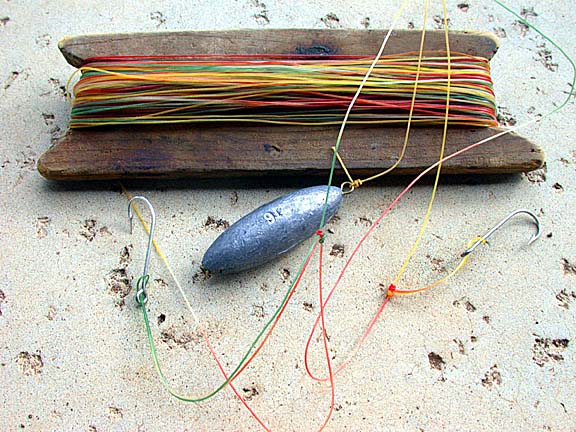
hand line

LONG LINES

Long lines can be classified by how they are fished: 
Set long lines: stationary lines that are anchored to the vessel, the seafloor or to an anchored buoy. 
Drift long lines: attached to floats that drift freely with the ocean currents. 

Long lines popularly known as beppe is operated in all places for fish and eel.  Mainline is 200-800 m long and is made of Polypropylene twine of 2 to 3 mm diameter or Poly amide monofilament of l to1.2 mm diameter. Generally round barbed hook of size ranging from number 8-12 are used depending on the target species. Prawns and cut pieces of fish are used as bait.Pelagic species targeted by drift long lines include Tunas, Sharks and Swordfish. Demersal species targeted by set long lines include Cod and Halibut. Long lining is considered one of the most fuel-efficient methods of commercial fishing. 


VERTICAL LINES

In enclosed water bodies the fishing lines can be allowed to drift freely attached to a float. lt can be a tackle with a single hook or a vertical or horizontal long line with several hooks. A kind of vertical line, popularly known as kenichi, is operated in weed infested canals and fields of Alappuzha, Kerala.
Jigger lines are a specialized type of vertical line, fitted with specialized ripped hooks, used primarily in Squid fisheries. Multiple hooks are evenly spaced along the main line, which is hauled in using jerky vertical movements. This movement simulates the realistic movement of common prey species of the targeted species. 

TROLLING LINES 

Trolling lines are lines with baited hooks that are dragged behind trollers as well as other types of vessels. Trolling speeds vary depending on the target species, but generally are between 2.6-8.1 mph. 
A single line or multiple lines may be connected to outriggers that extend from both sides of the boat.
 Targeted species vary in size from small fish like Mackerel to large pelagic species of tuna. 

POLE AND LINE

Pole and line consists of a hook and line attached to a pole. If the line is much longer than the rod it is wound around a reel. Both artificial and natural fish are used to lure the prey. Poles are commonly made out of wood or fiberglass and can be operated by hand or mechanized. Tuna species are commonly caught by the pole and line method in commercial fisheries of Lakshadweep. Pole and line fishing can occur from the surface to great depths, the only limiting factor is the amount of line used.
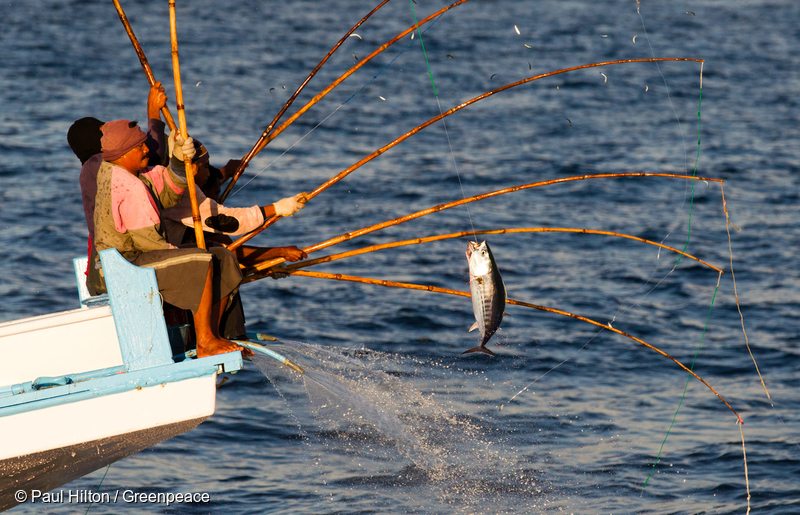
MULTIPLE HOOK AND LINES

Lines with multiple hooks, a type of jigging line with 20 to 30 branches on one end. The main line is made of PA monofilament having 1.2-1.4 mm dia. and about 80 m length. 20-30 branches each  having a hook. Length of the branch line is about 10 cm and it is tied to the main line at 10-15 cm intervals. A lead piece weighing 150-200 g is attached to the end of the line to keep the line under the current. This type of lines without bait is dropped from the dam and it is continuously pulled and released. 

Sunday, 15 April 2018

Mussel Culture

Mussels are among the many invertebrates under the Phylum Mollusca.  Their wide distribution in the coastal areas of the Indo-Pacific region makes them the most easily gathered seafood organisms, contributing a significant percentage to the world marine bivalve production. Culture of edible molluscs is now recognized as an effective way of enhancing food production and sea mussels among all the known cultivable organisms, give the highest production rate for two reasons:
 (1) They feed directly on the primary producers namely the phytoplankton
 (2) It is farmed three dimensionally in the water column at the farm site.
The world mussel production during 2006 was 1.89 million tons valued at 1.2 billion US dollars (FAO, 2008). The world production of Perna viridis during 2006 was 305,321 tons valued at 2.74 million US dollars.
The total production of green mussels in India (2008) is about 15,000 tons (CMFRI, 2009). China ranks first in the production of cultured mussels in the world, followed by Spain, Italy, Netherlands, Denmark and France.
TAXANOMY
Kingdom:  Animalia
Phylum:    Mollusca
Class:     Bivalvia
Subclass:     Pteriomorphia
Order:       Mytiloida
Family:    Mytilidae
Genus: Perna
Species: viridis

BIOLOGY
Mussels are sedentary animals with elongate, equivalved and in equilateral shells. The two valves are hinged at the anterior end with terminal umbo. External colour of the shell is green in Perna viridis and dark brown in Perna indica. Interior of the shell is margaritaceous and shining, muscle scar deeply impressed. Foot is finger-shaped, thick and extensible. Byssus threads emanate from the byssus stem and threads are long, thick, strong with a well developed attachment disc at their distal end. The mussels can discard the byssus threads and secrete new ones for enabling it to change its position. Phytoplankton forms the food of mussels and like oysters they are filter feeders.
Fig. green mussel (P. viridis)           Fig. brown mussel (P. indica)
 Reproduction
In mussels sexes are separate and reproduction and larval development are similar to that of edible oysters. The male gonad is creamy white and in females it is pink or reddish. The mussels attain maturity at very small lengths. The green mussel attains maturity at 15.5 to 28.0 mm. 
Larval development of mussels
Release gonad material (sperm and eggs) into the water i.e external fertilization. The fertilized eggs develop into trochophore in 6-7 hrs.  "D" shaped veliger in 20 hrs. Larvae are free swimming for 15-20 days. Locomotion is with the help of velum.  As the larvae metamorphose, the pedal organ developes. On formation of this the pediveliger larvae look out for a suitable substratum to settle. 
The larvae attach to the substratum by means of the byssus. The metamorphosis takes place and the secretion begins. The young metamorphosed larvae (plantigrade) is generally called "Spat" the ability of the animal to regenerate the byssus is an advantage for transplanting the animal to new areas in mussel farming operation.


Technology of mussel farming

Site location
In prospecting sites for mussel cultivation, well-protected or sheltered coves and bays are preferred than open un-protected areas. Sites affected by strong wind and big waves could damage the stock and culture materials and, therefore, must be avoided. Flood waters would instantly change the temperature and salinity of the seawater, which is detrimental to the mussel. Sites accessible by land or water transportation are preferred so that culture materials and harvests can be transported easily.
Water quality

Areas rich in plankton, usually greenish in color, should be selected. Water should be clean and free from pollution.  Sites near densely populated areas should not be selected in order to avoid domestic pollution. In addition, the culture areas should be far from dumping activities of industrial wastes and agricultural pesticides and herbicides. Waters too rich in nutrients, which may cause dinoflagellate blooms and render the mussels temporarily dangerous for human consumption, causing either gastro-intestinal troubles or sometimes paralytic poisoning, should be avoided.
Water physio-chemical parameters are also important factors to be considered. 
The area selected should have a water temperature ranging from 27–30 °C, which is the optimum range required for mussel growth. Water salinity of 27–35 ppt is ideal. A water current of 17–25 cm per second during flood tide and 25–35 cm per second at ebb-tide should be observed. Favourable water depth for culture is 2 m and above, both for spat collection and cultivation.

Seed collection and seeding

The major part of the seed required for farming is collected on ropes suspended from the rafts during the peak spawning period.  The spat settled on ropes are allowed to grow to a length of 30-40 mm. These half grown mussels are collected and transplanted to fresh ropes to avoid overcrowding and help further rapid growth and fattening. Seed mussels are also collected from the natural mussel beds during low tide. A well experienced farmer collects up to 100 kg of seed in one tide. These seeds are wrapped around the ropes with a loosely woven synthetic netting, which is specially manufactured for Spanish mussel farming. The seeded length of the rope is 8-10 m and these ropes are suspended from rafts 60-70 cm apart. In the raft culture, the seeds reach harvestable size of 70-100 mm by 18-24 months in the temperate waters.
Mussel seeds are collected from the intertidal and submerged mussel beds after the peak spawning season (September-November). Normally an experienced person can easily collect 20- 30 kg of mussel in one hour. 
The average seed size for farming is 15-25 mm and 600 g seeds are required for seeding 1 m length of the rope. Synthetic and coir ropes of 15-20 mm diameter are suitable for growing mussels from the rafts. The seeds are placed around the rope and securely wraped with knitted cotton cloth. The seeded ropes are suspended from the rafts, 0.5-1 m apart, with the lower free end of the rope about 2 m above the sea bed. An optimum of 60 ropes, each having 6 m seeded length can be suspended from a raft of 6 x 6 m size. The seed mussels get attached to the ropes by means of freshly secreted byssus threads in two to three days and the cloth disintegrates in seawater within about 10 days. After the suspension of seeded ropes the mussel culture farm needs only minimum attention to see that the rafts are in good shape and the ropes with growing mussels are hung properly.
Fig. spat collector nylon rope

Fig. spat collector pipes

Bottom type
Bottom consisting of a mixture of sand and mud has been observed to give better yields of mussel than firm ones. It also provides less effort in driving the stakes into the bottom. Shifting bottoms must be avoided.

Cultured mussel species
Among the mussels proliferating in the coastal areas of the tropical zone, the green mussel, Perna viridis (= Mytilus smaragdinus), called tahong in the Philippines, is the only species farmed commercially. In the temperate zone, it is the blue mussel, Mytilus edulis, as this species can grow at low seawater temperatures. The brown mussel, Modiolus metcalfei and M. philippinarum which form dense mats on muddy bottoms in shallow bays (Yap, 1978) are simply gathered.
Culture methods
Mussel culture, as practiced in many countries, is carried out by using a variety of culture methods based on the prevailing hydrographical, social and economic conditions.
Bottom culture
Bottom culture as the name implies is growing mussels directly on the bottom . In this culture system a firm bottom is required with adequate tidal flow to prevent silt deposition, removal of excreta, and to provide sufficient oxygen for the cultured animals. Mussel bottom culture is extensively practiced in The Netherlands, where the production of seeds is completely left to nature. If the natural spatfall grounds are unsatisfactory for growing, the seedlings are transferred by the farmer to safer and richer ground or to his private growing plots, until the marketable size is attained. Natural conditions control the quality and quantity of food in the water flowing over the farming plots. Marketable mussels are fished from the plots and undergo cleansing before being sold. This method requires a minimum investment. Disadvantages, however, of this type of culture is the heavy predation by oyster drills, starfish, crabs, etc. Also, siltation, poor growth and relatively low yields per unit culture area.

Intertidal and shallow water culture
The culture methods that fall under this category are usually practiced in the intertidal zone. The culture facilities are set in such a way that the mussels are submerged at all times. Culture methods are:

 Rack culture

This is an off-bottom type of mussel culture. Rack culture is predominantly practiced in the Philippines and Italy where sea bottom is usually soft and muddy, and tidal range is narrow. The process involves setting of artificial collectors on poles or horizontal structures built over or near natural spawning grounds of the shellfish. In the Philippines, this is called the hanging method of mussel farming. The different variations used are as follows:

Hanging method.

 The process starts with the preparation of the spat collectors or cultches. Nylon ropes or strings, No. 4, are threaded with coco fibre supported by bamboo pegs or empty oyster shells at 10 cm intervals. These collectors are hung on horizontal bamboo poles at 0.5 m apart (Fig. 2). A piece of steel or stone is attached at the end of the rope to prevent the collector to float to the surface. Setting of collectors is timed with the spawning season of the mussels. Spats collected are allowed to grow on the collectors until marketable size. Other materials utilized as collectors are rubber sheets and strips from old tires. Mussels are harvested by taking out from the water the ropes or strings and bringing them to the shore on a banca. The same collectors can be re-used after being cleaned of fouling organisms. Harvested mussels are cleansed of the dirt and mud by dipping the collectors several times in the water. The process maybe laborious, but the ease in harvesting and availability of local materials for culture purposes makes it very adaptable under local conditions.
Mussel hanging (bitin) culture
Mussel stake (tulos culture)

Stake (tulos) method.

 The stake method is midway between the rack and bottom methods. Bamboo poles, 4–6 m in length are staked firmly at the bottom in rows, 0.5–1 m apart during low tide in areas about 3.0 m deep and above (Fig. 3). In areas where water current is strong, bamboo poles are kept in place by nailing long horizontal bamboo supports between rows. Since mussels need to be submerged at all times, it is not necessary that the tip of the poles protrude above the low water level after staking. However, boundary poles should extend above the high water level. In staking, enough space between plots is allowed for the passage of the farmer's banca during maintenance.
Collected spats are allowed to grow in-situ until marketable size, 5–10 cm after 6–10 months. It has been observed, that about 2,000–3,000 seeds attach on 1 metre of stake, 1–2 m below low water level. The mussels are harvested by pulling out the poles and bringing them ashore on a banca. Some poles may still be sturdy and can be re-used during the next season.

Tray culture. 

Tray culture of mussels is limited to detached clusters of mussels. Bamboo or metal trays, 1.5 m × 1 m × 15 cm sidings are used (Fig. 4). The tray is either hang between poles of the hanging or stake methods or suspended on four bamboo posts.


Wig-wam culture. 

The wig-wam method requires a central bamboo pole serving as the pivot from which 8 full-length bamboo poles are made to radiate by firmly staking the butt ends into the bottom and nailing the ends to the central pole, in a wigwam fashion. The stakes are driven 1.5 m apart and 2 m away from the pivot. To further support the structure, horizontal bamboo braces are nailed to the outside frame above the low tide mark .Spats settle on the bamboos and are allowed to grow to the marketable size in 8–10 months.
Mussels are harvested by taking the poles out of water, or in cases that there are plenty of undersized bivalves, marketable mussels are detached by divers.

Rope-web culture.

 The rope-web method of mussel culture was first tried in Sapian Bay, Capiz, in 1975 by a private company. It is an expensive type of culture utilizing synthetic nylon ropes, 12 mm in diameter. The ropes are made into webs tied vertically to bamboo poles. A web consists of two parallel ropes with a length of 5 m each and positioned 2 m apart. They are connected to each other by a 40 m long rope tied or fastened in a zigzag fashion at an interval of 40 cm between knots along each of the parallel ropes . Bamboo pegs, 20 cm in length and 1 cm width are inserted into the rope at 40 cm interval to prevent sliding of the crop as it grows bigger. In harvesting, the rope webs are untied and the clusters of mussels are detached.
The method is laborious and expensive, but the durability of the ropes which could last for several years might render it economical on the long run. However, the effect of the culture method on the culture ground is detrimental as gradual shallowing of the culture area has been observed up to the point that the areas become no longer suitable for mussel farming.
   “Bouchot” culture
“Bouchot” culture is mainly undertaken in France. This is also called the “pole culture” or stake culture. The poles, used are big branches or trunks of oak tree, 4–6 m in length, which are staked in rows, 0.7 m apart on soft and muddy bottoms of the intertidal zone during low tide.�Mussel seeds are collected on coco-fibre ropes which are stretched out horizontally on poles. Young adults, 3–5 mm in size are placed in long netlon tubes (10 m in length) and attached around the oak poles in a spiral fashion, until marketable size.�Korringa (1976) reported that for an estimated length of about 600 km “bouchot” netlon, an approximate production of 7000 tons of marketable mussels yearly or an average production of 25 kg/pole/year can be harvested.

Deep water culture


-   Raft culture


Mussel raft culture has been practiced in Spain for a long time. Mussel seeds that settle freely on rocks or on rope collectors are suspended from a raft. When the weight of the bivalves on a given rope exceeds a certain limit, the rope is taken out and again distributed over a greater length until marketable size. It is a continuous thinning of the mussel stock to provide ample space to grow. Marketable shellfish are detached from the rope, purified in basins before marketing. The raft may be an old wooden boat with a system of outrigger built around it. Other kinds of rafts could be a catamaran-type boat carrying some 1000 rope hangings, or just an ordinary plain wooden raft with floats and anchors . Floats can be made of plastic, wood, oil drums, etc. The raft are transferred from one place to another using a motor boat. Production of mussels from this type of culture is high. Advantages of this type of culture are: reduce predation, utilization of planktonic food at all levels of water, and minimum siltation.

Long-line culture
Long-line culture is an alternative to raft culture in areas less protected from wave action. A long-line supported by a series of small floats joined by a cable or chain and anchored at the bottom on both end is employed. Collected mussel spats on ropes or strings are suspended on the line. The structure is fairly flexible.

Mussel culture- cycle


Harvesting procedure

Harvesters should be aware of the stress caused during the harvesting process. 
In harvesting mussels special care is needed. Pulling them or using a dull scraper may tear the byssal thread. This will result in loss of moisture after harvest or cause physical damage causing early death of the bivalve. The right procedure is to cut the byssal thread and leave it intact to the body. 
Exposure to sun, bagging and transport also increases the stress of the mussels.


PURIFICATION OF MUSSELS


Mussel is a sedentary bivalve growing attached to rocks or any other hard substratum in coastal waters by means of self secreted byssus threads. They are filter feeders and therefore at any given time their stomachs are likely to be loaded with mud/sand particles and bacteria. Hence depuration of mussels is very important. Legislation regarding sanitary requirements in marketing mussels can be classified into two groups. In most countries mussels can be marketed only when originating from clean waters, where regular analysis ensures that quality is maintained. However, in southern Europe (Spain and Italy) all mussels must be depurated, wherever they originate from. As a result there is less stringent enforcement as to water quality, where the mussels are grown. It is rather easy to purify mussels of bacterial pollution, because they cleanse themselves of this type of pollution bacteria if kept in clean filtered sea water for 24-48 hours. This treatment can also clean the mussels of mud and sand particles in the stomach.
The depuration process consists of three aspects: (1) pumping clear sea water into large storage tanks (2) sterilization of water using 2-3 ppm chlorine or 1-2 mg ozone/litre and (3)keeping mussels in sterilized water for 24-48 hours. Recently ozone is widely used for sterilization of water, as it is a powerful oxidizing agent capable of killing bacteria and viruses rapidly.

CONCLUSION

The fast growth rate of mussel makes it an ideal species for culture. 
The production can be augmented if mussel farming is taken up on a large scale. 
It offers scope for employment to the coastal fishers, increases foreign exchange earnings and an additional occupation for the fishing community with income potential.
The advantage of mussel culture in our waters when compared to the temperate region is that the rate of production here is very high. Here it takes only 5-6 months, because of the high productivity of the tropical waters. The peak spawning season of green mussel along the west coast of India is from August to October and along the east coast it is May-July.  Mussel culture, begin with be viewed as social necessity with a bias on nutritional improvement of the people and employment potential.


Saturday, 14 April 2018

Seed Production And Culture Of Lobsters

Lobster farming is currently reliant on a natural supply of wild plueruli. Two to three million plueruli are caught each year between October and March, of which around 70 per cent are P. ornatus and 25 per cent P. homarus.  The only other developed fishery for spiny lobster plueruli is in southeast Lombok, Indonesia, where around 5 lakhs plueruli are captured each year.  In this fishery, 90 per cent of the plueruli caught are P. homarus and the rest are primarily P. ornatus.Clawed lobsters comprise a family (Nephropidae, sometimes also Homaridae) of large marine crustaceans.
They have long bodies with muscular tails, and live in crevices or burrows on the sea floor. Three of their five pairs of legs have claws, including the first pair, which are usually much larger than the others. Highly prized as seafood, lobsters are economically important, and are often one of the most profitable commodities in coastal areas they populate.  Clawed lobsters are not closely related to spiny lobsters or slipper lobsters, which have no claws (chelae), or to squat lobsters. The closest living relatives of clawed lobsters are the reef lobsters and the three families of freshwater crayfish.

TAXONOMIC CLASSIFICATION

Kingdom           :    Animalia
   Phylum             :    Arthropoda
    Class                :    Malacostraca
Order                :    Decapoda
  Family               :    Scyllaridae

DISTRIBUTION

Lobsters can be found all over the world. They can be found throughout the Atlantic  and Pacific 
ocean at depth any where from 1m – 480m. They are usually found around depth of 40 – 50m. Large concentration can be found along the eastern US coasts and the water surrounding Europe. 
BIOLOGY

Spiny or rock lobsters have a sub cylindrical body with long cylindrical antenna with whip like flagellum. The carapace is covered with numerous spines and tubercles. The slipper or sand lobsters with a dorso-ventrally flattened body and short antenna without whip like flagellum. 
BREEDING
 Egg bearing females for the hatchery operation can be obtained from the wild or from captive brood stock. The brood stock can be built up either by growing juveniles to sexual maturity or bringing  sexually mature adult lobsters and induce them to breed under controlled conditions. Juveniles of the spiny lobster P homarus were reared to sexual maturity and successfully bred in captivity.  Food plays a major role in inducing maturation and for spiny lobsters, highest breeding activity was observed on feeding with mussel meat. For successful mating a female to male ratio 2: 1 was found to be sufficient.
SEED AVAILABILITY
Among the shallow water species occurring along the Indian coast, Panulirus homarus, P. ornatus, P. polyphagus and Thenus orientalis are the most promising species. These species can be easily distinguished by the colour and morphological features.The hatchery production of T. orientalis has already been accomplished. Artisanal gears such as trammel nets, gill nets and traps are also used for fishing in inshore areas.

Hatchery production of lobsters

 Hatchery production of lobster larvae (Phyllosoma) is technically challenging because of the protracted duration of larval development and the large number of moults involved and the delicate nature of the larvae.  Japanese research and development of hatchery technology is the most long-standing at over 100 years, but in recent times the most significant developments have come from Australia and New Zealand. Small numbers of plueruli have been produced in research hatcheries and several groups (government and private) are now commercialising their technology. 
NURSERY
 The captured plueruli are very delicate and mortality can be very high (>50 percent).
  The bulk of plueruli are transported in small  boxes.  The nursery phase typically involves stocking the plueruli at 50-100/m2 into submerged cages, consisting of mesh surrounding a steel frame.
 Each cage is placed on the sea floor at 2-5 m depth and a feeding tube from the surface to the cage provides the means to feed the baby lobsters. Finely chopped trash fish, crustaceans and molluscs are used as food. The nursery phase lasts for 3-6 months, during which the lobsters grow to 10-30 g. Floating nursery cages are 3 m x 3 m x 2 m deep, consisting of fine mesh, suspended from a floating bamboo frame.
The cages are furnished with seaweed (Gracillaria sp.); this provides shelter for the small lobsters. They are fed with chopped fish flesh and on-grown for 1-3 months until Farmed lobsters are traditionally fed a mixture of fish, crustaceans and molluscs which come from the fish markets nearby. This so-called ‘trash fish’ can be highly nutritious if fresh and handled appropriately. Food conversion ratios are often poor and considerable pollution occurs in the vicinity of the cages
The fecundity of P homarus ranges from 50,000 to 5 lakhs depending upon the size of the lobster.

 Though the fecundity of captive lobsters was estimated to be 20% lower than those of the wild, egg quality was comparable to that of wild lobsters and hatching gave viable larvae.The fecundity, yolk, carotenoid content, hatch percent of eggs and larval and considerable pollution occurs in the vicinity of the cages. Manufactured pellet diets are available, although there has been little uptake to date.

Larval rearing 

 The incubation period in tropical lobsters range from 20 to 25 days depending upon the water temperature. Newly deposited eggs on the abdominal pleopods change colour from deep orange to deep brown before hatching. Microbial infestation is relatively lesser in captive breeders. The breeder has to be transferred to the hatching tanks containing sterilized seawater as soon as the egg bearing lobster is cited in the brood stock tank. Moderate aeration is to be provided. Hatching takes place during night and the larvae are highly photo tactic. Healthy larvae actively swim on the surface of water and can be collected and transferred to larval rearing tank after estimating total larval numbers. 

Fig. Life stages of lobster

Transportation

Lobster seeds are first transported to farms, which on average takes up to 12 hours. Transport from the lobster farms to trading centers  occurs in open, aerated seawater tanks on trucks and normally takes anywhere from 7 to 20 hours.The live lobsters are then exported overseas once they are packaged in polystyrene boxes which are up to 20mm in thickness, together with plastic bags containing water and ice to help keep the lobsters cool. Small holes are also provided in the boxes for ventilation.

Growth Rate

Under sub-optimal rearing conditions, the Indian spiny lobsters, Panulirus homarus and P. polyphagus were grown from pluerulii to 80g size in 12-16 months and then to 30g in another 12 months.
 In the tiger lobster, P. ornatus, 380g size was obtained in 20 months.  Fattening of juveniles of 100 g and above to required commercial size is more promising than rearing pluerullii to marketable size.Three to seven fold growth enhancement was achieved in four species of Indian spiny lobsters by eye-stalk abalation. The tiger lobster has been grown from 100- 1500g in eight months by this technique. The ethics of enhancing growth by removal of eye-stalk and the consumer acceptance of eye less lobster are the points to be considered before applying this technique. Researchers find out the same result can be achieved by inactivating the eye-stalk hormones by laser or other modern techniques, rather than by eye-stalk abalation.

Cultivation in cages

After the lobster seed is sold to farmers, they are normally placed into sea cages and grown to adult size for harvest at about 1 kg. This takes about 18– 24 months. Three methods of cage culture exist. The first farming method, is a floating cage,  The second farming method is wooden fixed cages, made from 2.5m length by 10 cm width wood with salt resistance, placed about 2 m apart so to create a square shape and normally have an area of 20-40 m2 up to 100-200 m2 with varying cage size.

 The third cage farming method is the submerged cage method, made from iron mesh with meshing of 15–16 mm, with an overall size of the cage ranging from 1 - 16 m2 and with a height of 1 - 1.5 m.

Fig. stages in cage culture

 Feeding

After settling, young, lobster are quite aggressive competing for habitat and food. When cultured in Vietnam, lobsters are normally fed “trash” fish, such as lizard fish and pony fish, that are caught as a by-product of fishing activities. They  are also fed mollusk such as sea snails, oysters, and cockles etc.  These raw foods are given to the lobsters in the cages after being chopped into small pieces.

Factors influencing growth of lobsters

Water quality parameters in larval culture system of   spiny lobsters:- Temperature - 20.0 -21.5 o C Salinity (ppt)- 33.5-35.5 and PH- 8.0- 8.6.
Salinity, dissolved oxygen (DO), pH, temperature and nitrogenous metabolic wastes, especially, ammonia, are the major water quality parameters regulating lobster growth. Stocking density, provision of shelter, handling stress and intensity of light also influence growth in captivity. Quality of feed plays a major role in obtaining optimum growth and body colouration.

SCOPE FOR CULTURE / FATTENING OF INDIAN SPINY    LOBSTERS SEED

All commercially important species of shallow water spiny lobsters in India have been bred in captivity, but their whole larval cycle is yet to be completed. Scientists at the Central Marine Fishers Research Institute (CMFRI) were successful in rearing lobster larvae to more than half way stage and efforts are on to complete the larval rearing process. 


Seed Production And Culture Of Pompano


Pompano  is  the one  of  the  most  highly desired  brakishwater  fishes. It  has  an  excellent   flavour and  its monetary  value  is  high. Several  species  of  fishes  in various  part  of  the  world  have  the  common  name  Pompano.  We  restrict  this name  to  the  species  of  genus  Trachinotus  of  the  family  Carangidae.

CLASSIFICATION
Kingdom: Animalia
Phylum: Chordata
Class: Actinopterygii
Order: Perciformes
 Family: Carangidae
 Genus: Trachinotus
Species: mookalee 

BIOLOGY  OF POMPANO

Pompano,  (Trachinotus), any of several marine fishes of the family Carangidae (order Perciformes). Pompanos, some of which are highly prized as food, are deep-bodied, toothless fishes with small scales, a narrow tail base, and a forked tail. They are usually silvery and are found along shores in warm waters throughout the world. The Florida, or common, pompano (T. carolinus), considered the tastiest, is a valued commercial food fish of the American Atlantic and Gulf coasts and grows to a length of about 45 cm (18 inches) and weight of 1 kg (2 pounds).

FEEDING

In nature; young Pompano feed relatively on  benthic and pelagic invertebrates such as amphipods, bivalve mollusk, crab larvae,copepod and isopods; at times they feed heavily on  young of other fishes particularly clupieds. The adult appear to have similar food preferences. In captivity; the young grow well on a diet of mixed ground shrimp, fish and frozen brine shrimp. Fishmeal may be an adequate diet, Larger fish thrive on ground or chopped fish; they can also be feed ground scrap fish from trawl catches, chicken feed  and tankage from slaughter house.
GROWTH RATE
       Young Pompano in nature probably grow about 1/4 to 1/2 inches per month
      Fish in captivity has been raised from a length of about one inch to over 10 inches and a weight if about one pound within an year
TOLERENCE
      The  juveniles  and  adult  Pompanos  tolerate  a  wide  range  of  environmental  conditions  including  low  levels  of  dissolved  oxygen  and  salinities  ranging  from  0 -50 ppt
 FECUNDITY
       It’s  fecundity  has  been  estimated  to  range  from  133000 – 800000  per  season

CULTURE AND SEED PRODUCTION OF POMPANO

BROODSTOCK PROCUREMENT

    Pompano  can  be  collected throughout  the  year  from  the  Estuarine waters. Broodstock  can  be  collected  by  using  Trammel nets, Gill nets, Hooks & Line.  Gill nets  are  most  efficient  way  to  collect  large  numbers  of  adult  Pompanos. Pompanos  collected  offshore  can  be  held  for  a  short  time  in  the live  wells  on  boats  with  the use  of  liquid  Oxygen. Then  they  are  transported  to shore  and  transferred  to  tank  or  ponds  to  be  used  for  spawning. Juveniles  can  be  collected  from  wild  and  reared  in  captivity  until  they  reach  sexual  maturity. Viable  broodstock  also  can  be  obtained  from  hatchery  reared  Pompano.
SPAWNING  BEHAVIOUR: 
There   is  limited  information  in  the  spawning  behaviour  of captive  Pompano. Captured  Pompano  have  been  induced  to  spawn  year  round  using  hormone  injections  coupled  with  photoperiod  and  temperature  manipulation [photothermal manipulation] . Fishmeal may be an adequate diet of them. Spawning  was  induced  with  hormone  injections [Human Chorionic  Gonadotropin-HCG ]  based  on  body  weight coupled  with  photothermal  manipulation  to  produce  eggs in both  wild- caught  and  hatchery  reared  Pompano. For  this  fish  were  collected  in  a  smaller  tank  and  anazthetized  using  tricainemethanesulfonate[MS-222]. A cannula  tube  was  used  to  check  the  state  of  gonadal maturation. 
Both  males  and  females  given  a  single  intramuscular  injection about   halfway  between  the  lateral  line  and  first  dorsal  fin  spine. Females  with  vitellogenic  and/or  post  vitellogenic  stage  oocytes  were  injected  with  a  single  dose of  HCG  at 1000 IU/kg  body  weight. Male  received  a  single  dose  of  HCG  at  500 IU/Kg  body  weight. Spawning  occurs  40  to  48 hours  after  the  injection, followed  by  small, less viable  spawn  up to  96 hours  post  injection. In general the female pompano will produce 100000 fertilizable eggs per pound of total body weight.From  seven  documented  induced  spawning  for  wild  caught  and  hatchery – reared  Pompano  a  total  of  5.3  million  eggs  were  collected.


POMPANO  FARMING
In  view  of  the  limited  knowledge of biological requirements  and  tolerences  of  Pompano  the  following  recommendations  should  be  tentative. After  the  fry  are  netted  on  the  beach, they  should  be  moved  carefully  and  rapidly  to  a  carrying  tank  and  transferred  as  quickly  as possible  to  their  first  growing  pond  or  aquarium. Use  of  compressed  oxygen  or  air  may  be  needed  to  transport  the  fry  long  distances. Only  one  species  of  Trachinotus  should  be  stocked;  by  popular  preference,  it  should  be  common Pompano – Trachinotus mookalee . Larvae  and  fry  of  other  fishes  and  invertebrates  that  could  compete  with  the  Pompano  for  food  and  space  should  be  excluded  from  the  pond  if  possible.

The  young  Pompano  should  be fed  several  times  each  day. We  have  been  told  that  the  very  young  may  require  a  daily  ration  of  about  1/10  of  their  body  weight. A  finely  ground  food of  adult  brine  shrimp, fish  filets  and  whole  shrimp  has  proved  satisfactory  for  young  Pompano  in  the  first  two  months  or  so  after  capture. Ground  shrimp  heads  and  ground   or  cut  whole  scrap  fish   are  good  when  the  Pompanos  are  3  to  4  inches  long  and  larger. Fish  meal  suffices  for  fish  of  all  sizes,  but  small  pellets  of  fish  meal  are  more  economical  for  larger  fish. Newly  caught  fry  should  be  placed  in  an  aquarium  or  small  pond  for  a  few  days  or  weeks  for  observation   of  food  requirements. More  efficient  food  of   offered  and  culling  of  sickly  or  diseased  fish  and  of  other  fish  species  can  be  accomplished. Young  Pompano  should  not  be  retained  too  long  in aquaria  or  small  ponds  because  it  has  been  demonstrated  that  growth  of  fish  often  slows  when  they  are  crowded. Pompano  probably  grow  better  at  a nearly   constant  temperature. Extremes  of  temperature  especially  below  about  50F  are  usually  injurious  or  fatal.
Among  the  problem  that  need  to  be  investigated  are  the  following;
 1.Optimum  salinity  and  temperature  for  holding  the  Pompano.
 2.       Diseases  of  Pompano  which  could  affect  production.
 3.       Amounts  and  kinds  of  food  which  should  be  fed  to  Pompano  of  various  sizes.
 4.       Optimum  sizes  of  ponds  and  stocking  rates.
 5.       Important  biological  factors  such  as  growth  rates  and  life span.
In the United States, the market for pompano prefers them to be whole and fresh iced.
Only wild caught pompano exceeding 2 pounds in size are used for fillet market.
Due to the nature of the market demands the pompano farm must know what customers they are supplying on what days in order to keep fresh, low shelf life, product flowing to the markets. As of this time there is no value added processing of either wild or farmed pompano . Elements that determine pond productivity are water quality, water salinity, oxygen, temperature, food supply, avian predation, and jumping out of pond.  But the production losses due to the above mentioned parameters do not cause losses in excess of 10%. Therefore, the pond is originally stocked with 10% more fry or 5,500 per pond.
LARVAL CULTURE  
Fertilized  eggs  are  buoyant,  transparent  about 1mm  in  diameter  and  have  a  single  oil  droplet.  Newly  hatched  larvae  measure  approximately  2mm  standard  length [SL]   have  little  or  no  pigmentation,  lack  of  functional  mouth  and  have  a  large  yolk  sac  with  a  single  oil  globule.  At  7days  post  hatch  [DPH]  and a  temperature  of  28  degree  Celsius,  the  temperature  is  reduced,  the  yolk  is  fully  absorbed,  the  eyes  are  fully  pigmented  and  the  mouth  is  fully  formed. Transformation  from  larval stage   to  juveniles  begins  approximately  24 DPH  at  which  time  scales  develop  and  pigmentation  appears  over  the  lateral  surfaces  of  the  body. Fertilized  eggs    resulted  from  hormone  induced  natural  spawns   of  wild  caught  or   F1  Pompano  on the  day  of  spawning,   the  fertilized  egg  were   stocked  in  three  separate  rearing  tanks  at  densities  of  50  to  75 eggs/ L    and  incubated  at  26 degree Celsius. Hatching  began  24 hours  post  fertilization  and  hatch  rates  were  estimated  at  75.5 percent. Mean  larval  length  at  hatch  was  2.3mm SL.
              Rotifers, Artemia  etc  are the different  forms  of diet  that  feeds  the  Pompano  larvae  at  different  stages  of  development  with  different  quantities.The  concentration  of  feed  in the  larval  rearing  tank  should  be  check twice  daily. And  additional  feeds  are added  to  the tank  volumetrically  to  maintain  the  desired  number  of  individuals.Pompanos  have been grown  to  marketable  size  in  floating cages, tanks and in ponds.The  initial  weight  at  stocking  and  the  length  of  the  time  it  took  for  individuals  to  reach  marketable  size  varied  greatly  among  the  different  culture  systems. The typical  marketable  size  is 1  to  1.5  pounds  with  harvested  fish  measuring  9.8  to  14.2 inches TL [24.9 – 30.1cm].

DISEASES

The  broodstock  and  juveniles  collected  from  the  wild  can  carry  parasites  and  should  quarantined  and  treated  for  several  weeks  before  they  are  introduced  into  any  culture  systems. Amylodinium  is a  particular  problems for  both  juveniles  and  adults  in  recirculating  systems. This  parasite  has a  high reproductive rates  and  many  life  stages  and  tend  to  be  quiet  resilient  to  treatment. Amylodinioum  is  typically  found  on  the  gills  and  can  cause  high  mortality  rates  if  left  untreated. Individuals  infected  this  parasite  often  show  coughing  or  flashing  behaviour. 
Pompanos have  relatively  high demands  in local and  regional  seafood  markets and  it  is  highly  priced  by  recreational  fishers  also. The  juveniles  and  adult  Pompanos  tolerate  a  wide  range  of  environmental  conditions  including  low  levels  of  dissolved  oxygen  and  salinities  ranging  from  0 -50 ppt.

Featured post

PEARL FARMING - THE GOLD FARMING

Pearls have been known to mankind since the beginning of civilization.  These structures are secreted by the mantle (i.e., the skin) o...

Popular Posts